Wednesday, January 22, 2014
Gout Guidelines From ACR Include New Drugs, Diet
The ACR guidelines recommend treating patients with a xanthine oxidase inhibitor, such as allopurinol, as the first-line pharmacologic urate-lowering therapy approach. The recommended goal is to reduce serum urate to less than 6 mg/dL, and the initial allopurinol dosage should be no greater than 100 mg/d, the guidelines say. This should be followed by gradual increase of the maintenance dose, which can safely exceed 300 mg even in patients with chronic kidney disease.
"Clinicians often start allopurinol at doses that are too high but maintain allopurinol at doses that are too low," Dr. Terkeltaub said. "We give specific guidance on start low, go slow dose escalation."
To avoid allopurinol toxicity, the guidelines recommend considering HLA-B*5801 prescreening of patients at particularly high risk for severe adverse reaction to allopurinol (eg, Koreans with stage 3 or worse kidney disease and all patients of Han Chinese and Thai descent).
For CTGA, the guidelines recommend combination therapy, with 1 xanthine oxidase inhibitor (allopurinol or febuxostat) and 1 uricosuric agent, when target urate levels are not achieved. They advise using probenecid as an alternative first-line urate-lowering drug in the setting of contraindication or intolerance to at least 1 xanthine oxidase inhibitor (except in patients with creatinine clearance below 50 mL/min). They also recommend pegloticase in patients with severe gout disease who do not respond to standard, appropriately dosed urate-lowering therapy.
"We provide guidance for dose-escalation of urate-lowering therapy for specific case scenarios of mild, moderate, and severe disease including for patients with destructive joint disease that is chronic to their gout. These provide ways to assess the patient in an office setting on clinical findings alone, with serum uric acid. Pictorial representation of most severe patients should help identify who needs more intensive uric acid-lowering therapy," Dr. Terkeltaub said.
Acute Gout Requires Prompt Treatment
Part 2 of the guidelines covers therapy and prophylactic antiinflammatory treatment for acute gouty arthritis. These guidelines recommend initiating pharmacologic therapy within 24 hours of onset of acute gouty arthritis attack while continuing urate-lower therapy without interruption.
Nonsteroidal antiinflammatory drugs (NSAIDs), corticosteroids, or oral colchicine are the recommended first-line treatment for acute gout, and combinations of these medications can be used for severe or unresponsive cases.
To prevent the acute gout flares that may accompany the early stages of urate-lowering therapy, the guidelines recommend oral colchicine or low-dose NSAIDs as long as there is no medical contraindication or lack of tolerance.
Dr. Terkeltaub advised caution with colchicine dosing. "One of the major problems in quality of care is that people were getting drowned in colchicine for acute gout. We assessed the evidence and decided to go with the FDA [Food and Drug Administration]-approved regimen of low-dose colchicine for early acute gout flare. That is a major recommendation. When people get drowned in high doses of colchicine for a long time for acute gout, the rate of adverse events is quite high."
The recommendations were prepared during a 2-year project by an ACR task force panel that included 7 rheumatologists, 2 primary care physicians, a nephrologist, and a patient representative. The draft guidelines then went through 3 rounds of peer review, Dr. Terkeltaub said.
"I'd like to see better education of physicians and other primary caregivers, including nurse practitioners and physician assistants, and then better education of gout patients. If we only accomplish that, we'll have accomplished a lot. There has been a systematic failure of both quality of care and patient education in gout," Dr. Terkeltaub said.
Doug Campos-Outcalt, MD, scientific analyst for the American Academy of Family Physicians, reviewed the new guidelines for Medscape Medical News. Dr. Capos-Outcalt is chair of the Department of Family Medicine at the University of Arizona College of Medicine in Phoenix.
Dr. Campos-Outcalt said, "This is a reasonable, limited number of guidelines that are implementable. You don't like to see guidelines that have 50 recommendations. The ACR guidelines also present, from a family physician perspective, no major changes in standard-of-care." However, Dr. Campos-Outcalt suggested that a broader effort to disseminate the guidelines to primary care physicians will be needed because few of them regularly read the journal in which the guidelines appear.
Dr. Campos-Outcalt told Medscape Medical News that the guidelines seem reasonable but that before being influenced by them, he would like to take a closer look at the level of evidence each recommendation is based on. "We don't like to see recommendations based on low-level evidence," he said. Only about 20% of the ACR recommendations were based on top-quality "level A" evidence (supported by more than 1 randomized clinical trial or meta-analysis). About half of the recommendations were based on level C evidence (consensus opinion of experts, case studies, or standard of care).

Friday, December 20, 2013
4 Essential (and Overlooked) Facts About Your Brain and Your MinD
By Alvaro Fernandez | Dec 18, 2013
Monday, November 11, 2013
Tips for trouble-free exercise
Exercise Prescription
- Author: Amer Suleman, MD; Chief Editor: Sherwin SW Ho, MD more..
- Lift and lower weights slowly to maximize muscle strength and to minimize the risk of injury.
- Perform resistance workouts on any given muscle group every second or third day. This gives your body a chance to recover.
- Avoid exercise that puts excessive stress on the bones, such as running or high-impact aerobics. Rowing is appropriate if proper form is used and the rowing machine provides a way to maintain continuous inertia with the use of a flywheel.
- Stiffness is normal the morning after exercise. If pain continues for most of the following day, joints become swollen, or a limp develops, stop the program until comfortable again and reduce the weight and number of repetitions by 25-50%. If bone, joint, or muscle pain is severe, call the doctor.
- If a particular area of the body feels sore right after exercise, apply ice for 10-15 minutes. Wrap ice in a towel or plastic bag or just hold a cold canned or bottled beverage on the spot.
- Vary the routine to make it more interesting. For example, if the strength-building program involves 12 separate exercises, complete 6 in one session and the other 6 in the next session.
Exercise Prescription
- Author: Amer Suleman, MD; Chief Editor: Sherwin SW Ho, MD more..
Selecting the right physical activities
- Select physical activities that are enjoyable, use most of the muscles, are rhythmic, and may be sustained for several minutes to an hour.
- Plan to exercise every other day until more adequately adapted to the activity.
- Think of the frequency, intensity, time, and type (ie, FITT) plan.
- Frequency: This is how often per week one will perform the exercise. Plan on most days of the week.
- Intensity: This is how hard one exercises. Moderate effort is appropriate.
- Time: This is the duration of each session. Start off with as little as needed (10 min if necessary).
- Type: This is the choice of physical activity, which can include recreational activities and domestic or occupational activities. A short list of each follows:
- Recreational activities
- Participating in aerobic activity classes; performing calisthenics, gymnastics, low-impact aerobics, martial arts
- Backpacking, climbing hills, stair climbing, walking, hiking, orienteering, running
- Playing badminton, baseball, basketball, catch (eg, flying discs), cricket, handball, racquetball, lacrosse, rugby, shuffleboard, table tennis, tennis, volleyball, water polo
- Body building, bowling, boxing, cycling, dancing, fencing, gardening, golfing, horseback riding, hunting, in-line skating, skating, rope skipping, skiing, snow shoeing, weight lifting, windsurfing
- Canoeing, sailing, scuba diving, swimming, fishing, participating in water activities
- Domestic or occupational activities – Cleaning windows, doing housework, mowing, packing and unpacking, plowing, sanding, sawing, sweeping, stocking shelves, pushing a wheelbarrow, performing yard work, etc
- Recreational activities
- Set goals, which may include those regarding health, improving physical capacity or performance.
- Motivation may be helpful for compliance. See the following tips:
- Join a class or facility, or contract with a friend (buddy system).
- Listen to one's body (eg, slowing down or skipping if tired or ill). Start at the present level to prevent soreness.
- Exercise at the same time each day.
- Make sure to have good-quality nutrition.
- Make exercising a priority; scheduling a time benefits the individual.
- Get advice if help is needed.
Exercise Gains Momentum as Psychiatric Treatment
November 16, 2012 SAN DIEGO, California – The benefits of exercise in nearly every aspect of physical health are well known, but evidence in recent years suggests a unique effect on some psychiatric disorders, prompting mental health clinicians to rethink treatment strategies and to consider the possibility of exercise not just in therapy but as therapy.
"Above and beyond the standard benefits of exercise in healthy living and general well-being, there is strong evidence demonstrating the ability of exercise to in fact treat mental illness and have significant benefits on a neurotrophic, neurobiologic basis," Douglas Noordsy, MD, told delegates attending Psych Congress 2012: US Psychiatric and Mental Health Congress.
Some of the strongest evidence is seen in depression, where psychiatric benefits from exercise have been shown in some cases to match those achieved with pharmacologic interventions and to persist to prevent remission in the long term.
Dr. Noordsy referenced a study from researchers at Duke University in which 156 patients with major depressive disorder (MDD) were randomly assigned either to aerobic exercise, sertraline therapy (50 mg to 200 mg), or both for 4 months.
The difference in remission rates in the exercise and selective serotonin reuptake inhibitor (SSRI) groups after 4 months were not significant – 60% and 69%, respectively, but at a 10-month follow-up, the exercise group showed a significantly lower relapse rate (P = .01) (Psychosom Med 2000;62:633-638).
"The patients who were independently exercising on their own after the treatment period had half the odds for meeting the depression criteria 6 months later compared to patients who didn't exercise after the 4-month study," said Dr. Noordsy, an associate professor and director of psychosis services at the Geisel School of Medicine at Dartmouth College, in Hanover, New Hampshire.
A similar study from the same group of researchers 10 years later in a larger sample involving 202 patients assigned to supervised exercise, sertraline therapy (50 mg to 200 mg) or placebo showed remission rates of 46% at 4 months and 66% at the 16-month follow-up across both treatment groups, with no significant greater improvement with SSRIs compared with exercise in predicting MDD remission at 1 year (Psychosom Med 2011 Feb-Mar;73:127-33; epub 2010 Dec 10).
Other studies have shown equally impressive results in exercise for a variety of populations, including pregnant women with depression, who have a high interest in avoiding medications, people with HIV, and even patients with heart failure, who showed not only a significant reduction in depression related to exercise but also reduced mortality (Am J Cardiol 2011;107:64-68).
Anxiety
The evidence in relation to anxiety, although not as strong, still suggests a benefit, and the rigors of a cardiovascular workout seem particularly suited to addressing the physiologic effects associated with anxiety, Dr. Noordsy said.
"We know that with anxiety, the heart rate goes up, you start breathing fast, and it kind of snowballs with more anxiety, and that can trigger a panic attack," he explained.
"So one of the important positive effects of physical exercise is it allows people to become conditioned to having their heart rate and respiratory rate increase when they're not associated with anxiety, thereby addressing the triggers."
Evidence is somewhat lacking in the area of bipolar disorder, but patients often have symptoms similar enough to depression to suggest a benefit, Dr. Noordsy said.
"The evidence on depression in bipolar disorder is strong enough that I certainly feel comfortable in talking about exercise as part of [bipolar patients'] management."
In terms of more serious psychotic disorders such as schizophrenia, evidence is limited on benefits of exercise for the core symptoms of psychosis or cognition. However, several studies have shown improvement in comorbidities and metabolic issues related to antipsychotics that such patients commonly face.
One study of a jogging intervention among 80 inpatients with chronic schizophrenia, in which 40 patients jogged for 40 minutes 3 times a week, depression, anxiety, phobia, and obsessive-compulsive behaviors declined significantly compared with 40 inpatient control participants who were inactive and showed no improvement.
Dementia Prevention
The evidence on the benefits of exercise in cognitive function disorders, such as dementia and Alzheimer's disease, is much more extensive, with as many as 8 strong studies on dementia alone in the last 3 years showing improvements with activities such as walking and strength training on memory and executive function.Dr. Noordsy noted one particularly remarkable study in which researchers compared patients with and without the ApoE gene, which is linked strongly to late-onset Alzheimer's disease.
In the study, patients who were ApoE-negative showed similarly low mean cortical binding potential, related to plaque buildup in the brain, regardless of whether they exercised or not.
But although ApoE-positive individuals (n = 39) had values that were substantially higher, the ApoE-positive patients who exercised (n = 13) had values similar to those who did not carry the gene (Arch Neurol 2012;69:636-643).
"You could look at these results and rightfully say physical exercise neutralizes your risk for developing Alzheimer's disease if you're ApoE positive," Dr. Noordsy said.
How to Get Patients Moving
Perhaps the biggest caveat with all mental health conditions is how to motivate patients who are struggling with psychiatric disorders to exercise.
Dr. Noordsy offered some key suggestions:
- Start with an assessment: "I start with an assessment of lifetime history of activity and current activity in my baseline assessment template," Dr. Noordsy said. "I educate the patient on the potential effects of exercise on their disorder and how it fits on the menu of other treatment options."
- Make clear recommendations: "There is a lot of evidence in areas such as smoking cessation and in the addiction literature showing that a substantial subset of people will respond to very clear recommendations," he said.
- Offer motivational tools: A behavioral planner, for instance, that allows for goal setting, or connecting a patient with an exercise group can be helpful.
- Consider the patient's current activity capacity in recommending a regimen: "The general amount of exercise believed to result in a benefit is about 30 to 60 minutes per day, between 3 and 7 days per week." Some studies have shown strength training to be as beneficial as aerobic activity. For the latter, Dr. Noordsy suggested that one easy method often used in determining maximum heart rate, in general, for people without heart disease or other conditions is to simply subtract their age from 220.
- Help the patient find an activity that works best for them, rather than recommending anything specific, Dr. Noordsy suggested. "Have the patient choose the activity that is right for them."
- Help guide the patient to educational resources, such as information sources or books. "The book I've used the most with patients is John Ratey's Spark: The Revolutionary New Science of Exercise and the Brain," Dr. Noordsy recommended. "The book is very scientific and accessible to a lay audience," he said.
Importantly, discussing the role of exercise in the context of human evolution might be a more effective approach with patients than the standard recommendation to get some exercise.
"Instead of 'this is something you ought to be doing,' we might instead say, 'this is something humans are designed to do, and when we don't do it, our bodies and brains fall apart'."
Another important component in helping patients benefit from exercise is simply to improve awareness among clinicians, Dr. Noordsy added.
"We see evidence on the benefits of exercise for psychiatric conditions coming together, and there is a need to increase awareness of this among clinicians as well as reinforce the research community to be taking a more careful look at physical exercise," he said.
"This may not have as much of an industrial backing as some of the other interventions we use, but I think it's quite exciting."
Psych Congress 2012: US Psychiatric and Mental Health Congress. Presented November 9, 2012.
Even a Little Physical Activity May Prevent Depression
Deborah Brauser
November 07, 2013
Even low levels of physical activity may reduce the risk of developing depression in individuals of all ages, new research suggests.
In 25 of 30 large studies examined in the systematic review, which included participants between the ages of 11 and 100 years, a "negative risk" was found between baseline physical activity (PA) and the future development of depression.
In addition, this inverse association was found in all levels of PA ― including less than 2.5 hours of walking per week.
"It was a little surprising that 25 of the studies found this protective effect, and that's really promising," lead author George Mammen, PhD candidate from the Faculty of Kinesiology and Physical Education Department at the University of Toronto in Ontario, Canada, told Medscape Medical News.
"We also did quality assessments on each study, and the majority were of high methodologic quality, which adds weight to the findings," said Mammen.
He noted that the take-home message is that being active is important for more than just physical health.
"From a population health perspective, promoting PA may serve as a valuable mental health…strategy in reducing the risk of developing depression," write the investigators.
The study was published in the November issue of the American Journal of Preventive Medicine.
Prevention Strategy Needed
Previous studies have shown a link between exercise and decreasing symptoms in patients with depression, including several reported by Medscape Medical News.
"However, with the high prevalence of depression worldwide and its burden on well-being and the healthcare system, intuitively, it would make more sense…to shift focus toward preventing the onset of depression," the investigators write.
After searching 6 of the top databases, including MEDLINE and PubMed, the researchers found 6263 worldwide citations of PA and depression. For this analysis, they selected 30 English-language studies that were published between January 1976 and December 2012."We need a prevention strategy now more than ever. Our health system is taxed. We need to…look for ways to fend off depression from the start," added Mammen in a release.
All were prospective, longitudinal, and "examined relationships between PA and depression over at least two time intervals." They had follow-up periods ranging from 1 to 27 years.
Results showed that 25 of the studies revealed a significant inverse effect between any PA reported at baseline and subsequent depression development.
Interestingly, 4 of these studies showed that women who reported baseline PA were less likely than men to develop depression.
"These studies postulate that psychological factors may explain these findings because women may benefit more from the social aspects of PA than men," note the investigators.
Of the 5 studies that did not find a significant association between PA and depression, "only 1 was considered to be of high quality," and 2 focused only on older adults.
Get Moving
Using data from the 7 studies that measured amounts of weekly PA participation, the researchers found that exercising more than 150 minutes per week was associated with a 19% to 27% decreased risk of developing depression.
Brain Clears Toxins During Sleep
Medscape Medical News > Neurology
Scientists have long wondered why sleep is restorative and why lack of sleep impairs brain function.
Now, new animal research suggests how the sleep state may help clear the body of potentially toxic central nervous system (CNS) metabolites.
Proteins linked to neurodegenerative diseases, including β-amyloid (Aβ), are present in the interstitial space surrounding cells in the brain. In a series of experiments, researchers tested the hypothesis that Aβ clearance is increased during sleep and that the sleep-wake cycle regulates the glial cell–dependent glymphatic system, which is responsible for clearing waste from the brain and spinal cord.
"Basically, we found a new function of sleep," said study lead author Lulu Xie, PhD, Division of Glial Disease and Therapeutics, Center for Translational Neuromedicine, Department of Neurosurgery, University of Rochester Medical Center, New York.
"When mice are awake, the brain cells continuously produce toxic waste. This waste can build up in the spaces between the brain cells and damage them. However, during sleep, the spaces between brain cells increase, which may help the brain flush out the toxic waste. Therefore, a good sleep can clear the brain."
"Sleep changes the cellular structure of the brain. It appears to be a completely different state," Maiken Nedergaard, MD, DMSc, codirector of the Center for Translational Neuromedicine at the University of Rochester Medical Center, who is a leader of the study, said in a statement from the National Institute of Neurological Disorders and Stroke, which supported the study.
The new research was published October 18 in Science.
Sleeping vs Awake Brain
The researchers infused fluorescent dye into the cerebrospinal fluid (CSF) of mice and observed it flow through the brain. At the same time, they monitored electrical brain activity and wakefulness with electrocorticography (EcoG) and electromyography (EMG).
Dye flows through the brain of a sleeping mouse.Courtesy of Nedergaard Lab, University of Rochester Medical Center.
|
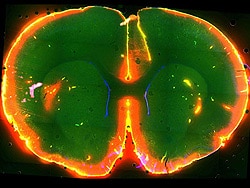
"In the sleeping brain, we found the CSF flushed into the brain very quickly and broadly," said Dr. Xie. "After half an hour, we woke the mice up by gently touching their tails, and injected another color of dye. But what we saw is that CSF barely flowed when the same mice were awake."
These results suggest that the awake brain may have more resistance to CSF influx, which leads to the assumption that the path of CSF flow into the brain is smaller in the awake brain, said Dr. Xie.
Next, the scientists inserted electrodes into the brain to directly measure the space between brain cells, and found that it increased by around 60% when the mice were asleep.
"Theoretically, big spaces lead to easier fluid influx," said Dr. Xie. "So we presumed that the clearance of the toxic protein between cells will become more efficient."
To test this assumption, they infused radio-labeled Aβ into the brain and measured how long it stayed in both the sleeping brain and the awake brain.
"We found Aβ disappeared 2-fold faster in the sleeping mice brains as compared with awake mice," noted Dr. Xie. "Based on this experiment, we can see that the sleeping brain is more capable of clearing out the toxic protein."
Technically, it might be relatively easy to study these processes in humans, possibly using magnetic resonance imaging. However, Dr. Xie said she does not know when human trials, which involve "a lot more concerns" than animal experiments, might come about.
"These results may have broad implications for multiple neurological disorders," said Jim Koenig, PhD, a program director at the National Institute of Neurological Disorders and Stroke (NINDS), which funded the study, in a statement. "This means the cells regulating the glymphatic system may be new targets for treating a range of disorders."
The study was funded by grants from the NINDS.
Science. 2013;342:373-377. Abstract
Subscribe to:
Posts (Atom)